Go Logging Libraries
Go logging libraries emphasize simplicity and performance. Zerolog, Zap, Logrus, and others feature zero allocation, structured logging, and fast processing, making them suitable for microservices and cloud-native applications.
Key Features
- Multiple Output Levels
- Structured Logging
- High Performance
- Multiple Output Destinations
- Rich Ecosystem
Representative Libraries
- Pino: Ultra-fast JSON logging library
- Winston: Most versatile logging library
- Bunyan: Structured JSON-focused logging library
- Morgan: Express.js HTTP logging middleware
GitHub Star Comparison
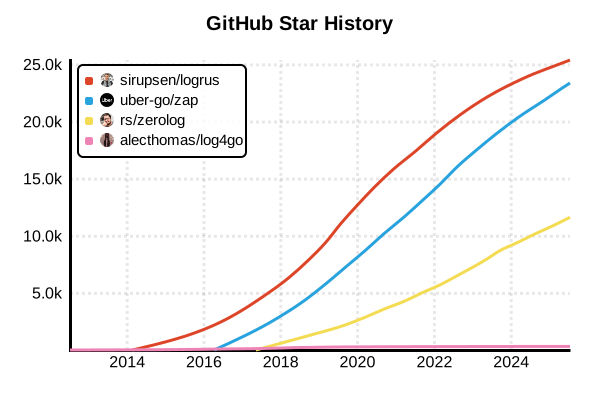
| No | Name | GitHub Stars | Description | Trend | License | Type | Official Site |
|---|---|---|---|---|---|---|---|
| 1 | log/slog (Standard Library) | - | Structured logging functionality introduced in Go 1.21 standard library. Provides production-ready high-performance logging features without external dependencies. Recommended choice for new projects due to excellent balance of features and simplicity. | Rapidly establishing as first choice for new projects in Go 1.21 and later in 2025. Long-term support guaranteed as standard library, many developers cite 'slog didn't exist when project started' as reason for not using slog. | BSD-3-Clause | Built-in Framework | Official |
| 2 | Zerolog | - | Fastest structured logging framework in Go. Achieves excellent performance of 35 ns/op with 0 allocations. Adopted by companies like CrowdStrike, recording highest speeds in almost all benchmark scenarios. | Established position as top candidate for high-performance applications in 2025. Adoption continues in systems where nanosecond-level performance is critical. Evaluated as standard choice alongside Zap when high-performance requirements exist. | MIT | Zero-allocation Logger | Official |
| 3 | Uber Zap | - | High-performance, structured, leveled logging library developed by Uber. Achieves 67 ns/op, 0 allocations performance with speed comparable to Zerolog. Surpasses Zerolog in customization capabilities, popular in Go ecosystem. | Maintains popularity in Go community in 2025, supported as choice for scenarios requiring high-performance requirements and customization. Evaluated as reliable choice due to enterprise environment track record and Uber's continuous maintenance. | MIT | Structured Logger | Official |
| 4 | Logrus | - | One of veteran Go logging frameworks. Maintains relevance in 2025 due to rich feature set and community support. However, no longer viable option for high-performance applications, but effective when prioritizing feature richness. | Continued use in existing projects still seen in 2025, but adoption in new projects declining. May still be selected in feature-focused projects, but avoided in high-load environments due to performance constraints. | MIT | Traditional Logger | Official |
| 5 | log4go | - | Go logging library inspired by Java log4j. Provides configuration methods and API design familiar to Java developers. Traditional configuration-based logging framework applying concepts like appenders, layouts, and filters to Go. | Selection examples still exist in development teams with Java background in 2025, but other choices tend to be prioritized in modern Go development. Issues with maintainability and adaptation to latest Go conventions, low recommendation for new projects. | BSD-3-Clause | Configuration-based Logger | Official |