Java Logging Libraries
Java logging libraries form a mature ecosystem meeting enterprise-level requirements. SLF4J, Log4j2, Logback, and others provide high performance, flexible configuration, and extensive output support with proven track records in large-scale systems.
Key Features
- Multiple Output Levels
- Structured Logging
- High Performance
- Multiple Output Destinations
- Rich Ecosystem
Representative Libraries
- Pino: Ultra-fast JSON logging library
- Winston: Most versatile logging library
- Bunyan: Structured JSON-focused logging library
- Morgan: Express.js HTTP logging middleware
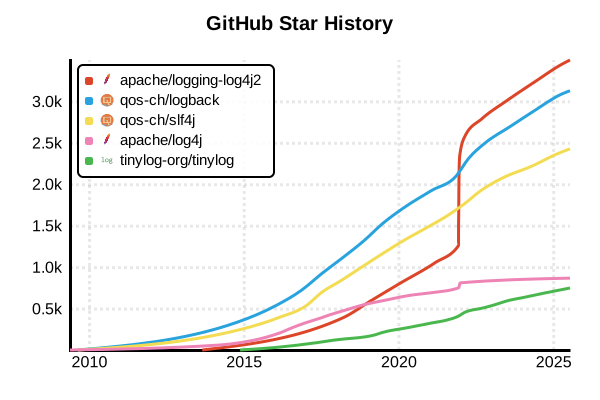
GitHub Star Comparison
| No | Name | GitHub Stars | Description | Trend | License | Type | Official Site |
|---|---|---|---|---|---|---|---|
| 1 | Apache Log4j2 | ⭐ 3.5k | High-performance logging framework by Apache Foundation, successor to Log4j. Supports garbage-free logging, asynchronous loggers, and lazy evaluation using lambda expressions. Optimized for low-latency systems through lock-free data structures. | Evaluated as fastest and most advanced Java logging framework in 2025. Adoption rapidly increasing in high-throughput applications. Established position in enterprise systems through garbage collection pressure reduction features and multi-threading capabilities. | Apache-2.0 | Advanced Framework | Official |
| 2 | Logback | ⭐ 3.1k | Logging framework developed by founder of Log4j. Provides native SLF4J integration, automatic configuration reload, conditional processing, and archived log compression. Widely adopted as mature and reliable solution. | Maintains stable position as first choice for many Java developers in 2025. Established as default choice in Spring Boot ecosystem. Balanced robustness and ease of implementation valued, adoption continues in medium-scale projects. | EPL-1.0/LGPL-2.1 | Traditional Framework | Official |
| 3 | Apache Log4j (Legacy) | ⭐ 868 | Historic Java logging framework by Apache Foundation. Used in many Java applications for years, but migration to Log4j2 is strongly recommended due to discovery of security vulnerabilities (Log4Shell). | Not recommended for new development in 2025, in maintenance mode for existing systems. Migration to Log4j2 or Logback is urgent due to security vulnerability impact. Only involved in legacy system maintenance work. | Apache-2.0 | Deprecated Framework | Official |
| 4 | Tinylog | ⭐ 748 | Lightweight and simple Java logging framework. Achieves high performance with minimal configuration, characterized by small footprint. Optimized for developers who want to avoid complex configuration and resource-constrained environments. | Gaining attention in 2025 due to proliferation of microservices and containerization. Lightweight nature and performance valued, increasing adoption in cloud-native applications. Suitable for use in Docker environments and serverless functions. | Apache-2.0 | Minimal Framework | Official |
| 5 | SLF4J (Simple Logging Facade for Java) | - | Industry standard logging abstraction layer for Java. Provides unified API for various logging frameworks like Log4j, Logback, java.util.logging. Allows selection of implementation library at deployment time, avoiding vendor lock-in. | Maintains unshakeable position as standard abstraction layer for Java logging in 2025. Established as essential choice in enterprise applications. Demand continues to expand as importance of unified log management across different services increases in microservices era. | MIT | Logging Facade | Official |
| 6 | java.util.logging (JUL) | - | Built-in logging API included in Java standard library. Available without external dependencies, providing basic logging functionality. Equipped with standard features like log levels, handlers, and formatters. Suitable for small-scale applications. | Demand continues for small-scale applications and learning purposes in 2025. Retains certain value as lightweight solution requiring no complex configuration. However, migration to dedicated frameworks is recommended in enterprise environments due to feature limitations. | Oracle JDK License | Built-in Framework | Official |