Rust Logging Libraries
Rust logging libraries achieve memory safety and zero-cost abstractions. log, tracing, env_logger, and others feature compile-time optimization, async support, and low overhead, making them suitable for systems programming.
Key Features
- Multiple Output Levels
- Structured Logging
- High Performance
- Multiple Output Destinations
- Rich Ecosystem
Representative Libraries
- Pino: Ultra-fast JSON logging library
- Winston: Most versatile logging library
- Bunyan: Structured JSON-focused logging library
- Morgan: Express.js HTTP logging middleware
GitHub Star Comparison
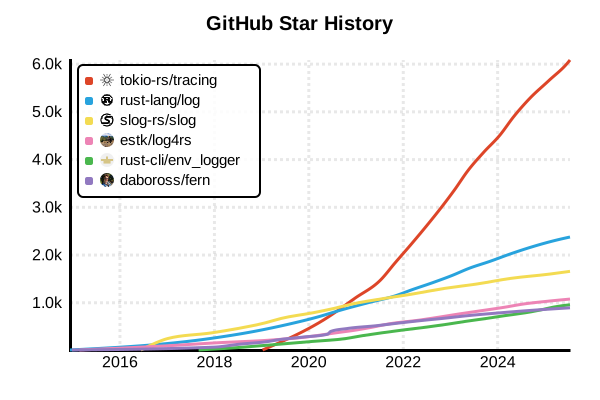
| No | Name | GitHub Stars | Description | Trend | License | Type | Official Site |
|---|---|---|---|---|---|---|---|
| 1 | log | - | Lightweight logging facade maintained by Rust core team. Provides single API abstracting actual logging implementation. Manages log levels with five macros: error!, warn!, info!, debug!, trace!. Standard choice for library development. | Maintains unshakeable position as foundation of Rust ecosystem in 2025. Serves as learning starting point for new Rust developers as first crate introduced in Rust Cookbook. Standard practice recommends linking only to log crate in library development. | MIT/Apache-2.0 | Logging Facade | Official |
| 2 | env_logger | - | Most downloaded Rust logger implementation (41 million downloads). Characterized by minimal configuration via environment variables, controls log level with RUST_LOG environment variable. Adopted in many Rust projects due to simple and reliable operation. | Maintains highest market share as de facto standard for Rust logging in 2025. Used widely from beginners to advanced users due to easy configuration and reliable operation. Solid position in Rust ecosystem with continuous adoption expected. | MIT/Apache-2.0 | Environment Logger | Official |
| 3 | tracing | - | Modern Rust library providing structured, asynchronous logging and span-based observability. In addition to traditional logging macros (info!, error!, etc.), supports distributed tracing and metrics collection. Optimized for monitoring in microservices environments. | Rapid adoption expansion in Rust development for microservices and cloud-native environments in 2025. Gaining attention as choice for full-scale production systems due to increasing importance of structured logging and distributed tracing. Becoming standard choice for modern Rust projects emphasizing observability. | MIT | Tracing Framework | Official |
| 4 | slog | - | Structured, contextual, extensible, composable logging library for Rust. Designed to be superset of standard log crate. Composition is strong selling point of slog, enabling flexible logger construction. | Adoption continues in Rust projects requiring advanced customization and structured logging in 2025. Selection examples seen in enterprise-grade Rust applications due to ability to handle complex requirements through composition features. However, general adoption limited due to high learning cost. | MPL-2.0 | Composable Logger | Official |
| 5 | fern | - | Feature-rich Rust logging library. Provides log level configuration, detailed output destination customization, and flexible formatting features. Suitable for scenarios requiring detailed log control in medium to large-scale Rust projects. | Selection examples continue in Rust projects seeking feature richness in 2025. Used as alternative choice when advanced configuration features insufficient in env_logger are needed. However, new adoptions declining due to proliferation of tracing and slog. | MIT | Configurable Logger | Official |
| 6 | log4rs | - | Rust logging crate modeled after Java log4j. Ports philosophy of Java logging package most deployed in open source software to Rust. Maintains compatibility with log crate, usable while preserving existing paradigms. | Selection examples by Rust developers with Java background still exist in 2025. Adoption seen in corporate environments preferring configuration file-based management, but other choices tend to be prioritized in modern Rust development practices. Low new recommendation from maintainability perspective. | MIT/Apache-2.0 | Configuration-based Logger | Official |